|
Publication Date: Wednesday, August 04, 2004
Transportation sales tax on ballot
Transportation sales tax on ballot
(August 04, 2004) By Marion Softky
Almanac Staff Writer
Now it's up to the voters of San Mateo County.
Are at least two-thirds of them willing to continue paying a half-cent sales tax to raise money for transportation projects, ranging from fixing local potholes and pavement, to buses, bicycles, shuttles, Caltrain, grade crossings, freeway interchanges, BART, ferries, and the disabled?
The Board of Supervisors on July 27 voted unanimously to put on the November ballot the proposed reauthorization of the Measure A half-cent sales tax for transportation.
The new Measure A would start in 2009, when the current Measure A, authorized by the voters in 1988, expires. It would extend over 25 years, until 2034.
When the current Measure A expires in 2008, it will have pumped more than $1 billion into county transportation projects, and attracted an additional $1.2 billion in federal and state matching funds. If passed in November, the next Measure A would bring in $1.5 billion over 25 years; with federal and state matching funds, there would be $2 billion to $3 billion for county transportation projects.
Citing the year-long process that produced the complicated expenditure plan for the new Measure A, Mark Church, president of the county Board of Supervisors, said, "This is a well thought-out, comprehensive plan that will meet our transportation needs for years to come."
Mr. Church also chairs the board of the seven-member Transportation Authority, which administers Measure A.
The proposed Measure A came to the supervisors with strong community backing developed over more than a year of technical studies and public outreach, including three open houses and six workshops. All 20 cities in the county have approved the spending plan, which was adopted by the Transportation Authority in March and approved by the Metropolitan Transportation Commission.
Supporters turned out in force to last week's meeting. Fifteen speakers from different sectors of the community said they support the ballot measure; three opposed it.
"This is the most important source of transportation funding for San Mateo County. It is not a new tax," said Onolee Trapp of the League of Women Voters. "There have been compromises; there are still more programs than money."
Veteran Libertarian Jack Hickey noted that federal and state governments are in dire straits. "You want to take more money from them," he said.
Deberah Bringelson, president of the business group SAMCEDA, acknowledged that money is tight in Sacramento and Washington. "That money is going somewhere," she said. "(Some of) it should come to San Mateo County."
Stuart Flashman, attorney for Citizens for Better Transit, complained about the process for adopting the plan and said he could not get a copy. He also worried that the Transportation Authority could change projects at will. "You're buying a pig in a poke," he said.
Transportation Authority attorney David Miller explained limits on shifting money if projects fall through over the 25 years of the program. Money can be shifted only within categories and under specific conditions, he said.
What projects?
"It's hard to imagine what this county would be like without Measure A," said Supervisor Rich Gordon, who also serves on the Transportation Authority board. "We wouldn't have Caltrain; we wouldn't have BART," he said.
Among other things, the current Measure A bought the Caltrain right-of-way. In the South County, it also contributed funds to building the new Marsh Road interchange, auxiliary lanes along U.S. 101 under construction from Belmont to the Santa Clara County line, and numerous street and traffic projects.
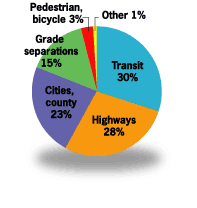
The money to be raised from the new Measure A would be divided among six categories: transit, 30 percent; highways, 27.5 percent; local cities and county, 22.5 percent; grade separations, 15 percent; pedestrian and bicycle, 3 percent; and other congestion relief programs, 1 percent.
The objectives of the new Measure A are to target key congested corridors, improve connections with regional transportation systems, increase safety, and improve mobility, especially for people with disabilities.
Major projects in the South County would include rebuilding the intersection of U.S. 101 and Woodside Road in Redwood City; and station facilities and enhancements for the Dumbarton rail service, which will be funded by a $1 increase in bridge tolls that took effect July 1.
The new list would allocate 16 percent of the future sales-tax revenue to Caltrain, including electrification of the Peninsula line and improvements along the future Dumbarton rail line. Unlike the current Measure A, money from the new measure could support operation of Caltrain service.
The 15 percent of the new funds allocated to grade separations could go to any of 41 places in the county where city streets cross the railroad line. Two of these are in Atherton, and four in Menlo Park. In addition, grade-separation money could go to streets crossed by the new Dumbarton rail line: Marsh Road, Chilco Street, and Willow Road in Menlo Park; and University Avenue in East Palo Alto.
Most contentious has been the allocation of 2 percent of the new Measure A funds to BART, and to new ferry service to South San Francisco and -- eventually -- Redwood City.
The BART funds -- $30 million over 25 years -- would be limited to maintenance and upgrades of the existing system, not to studying the feasibility of further extensions, the Transportation Authority board decided.
"This is a very modest amount for BART. We will use it in the most efficient way possible," said Howard Goode, retired chief development officer for the county's transportation agencies.
Supervisor Jerry Hill concluded a press conference following the board's
action with these words: "What a deal! We can leverage these funds to
$2 (billion) or $3 billion. Even in Las Vegas, you can't get those odds."
Measure A Funding
E-mail a friend a link to this story. |


